



The 4Cs Explained: How to Read a Diamond Before You Buy

The short version: Every diamond is graded on four qualities: Cut, Color, Clarity, and Carat weight, known as the 4Cs. They were developed by GIA, which also notes that Cut has the biggest effect on a diamond's beauty. Read the grades together, prioritize Cut, and always ask for an independent grading report.
Walk into any jewelry conversation and you will hear the same four letters: the 4Cs. They are the standard every reputable jeweler uses to describe and price a diamond, and once you understand them, comparing stones becomes far less intimidating. Here is what each one means and how to weigh them.
Where the 4Cs come from
The 4Cs, Cut, Color, Clarity, and Carat weight, were created by GIA (the Gemological Institute of America) in the mid-twentieth century. They gave the industry a single, objective language for diamond quality, which is why a GIA grading report is recognized worldwide. When you read a diamond's grades, you are reading that shared standard.
Cut: the C that creates sparkle
Cut refers to how well a diamond's facets interact with light, not its shape. GIA notes that of the 4Cs, Cut has the greatest influence on a diamond's sparkle and overall beauty. A precisely cut diamond returns light brilliantly; a poorly cut one looks dull even if it scores well elsewhere. For round brilliant diamonds, GIA grades cut from Excellent to Poor. If you protect one C, protect this one.
Color: how close to colorless
For a white diamond, color grading measures how little color it has. GIA's scale runs from D (colorless) to Z (light yellow or brown). The differences between neighboring grades are subtle, and many are hard to see once a diamond is set, especially in the near-colorless range. That is where a lot of buyers find the best balance of beauty and value.
Clarity: nature's fingerprints
Almost every diamond formed with tiny internal features called inclusions and surface features called blemishes. Clarity grades how noticeable these are, on GIA's scale from Flawless (FL) down through Internally Flawless, VVS, VS, SI, and Included (I). Many inclusions are invisible without magnification, so an 'eye-clean' stone a step or two down from flawless often looks identical to the naked eye while costing considerably less.
Carat: weight, not size
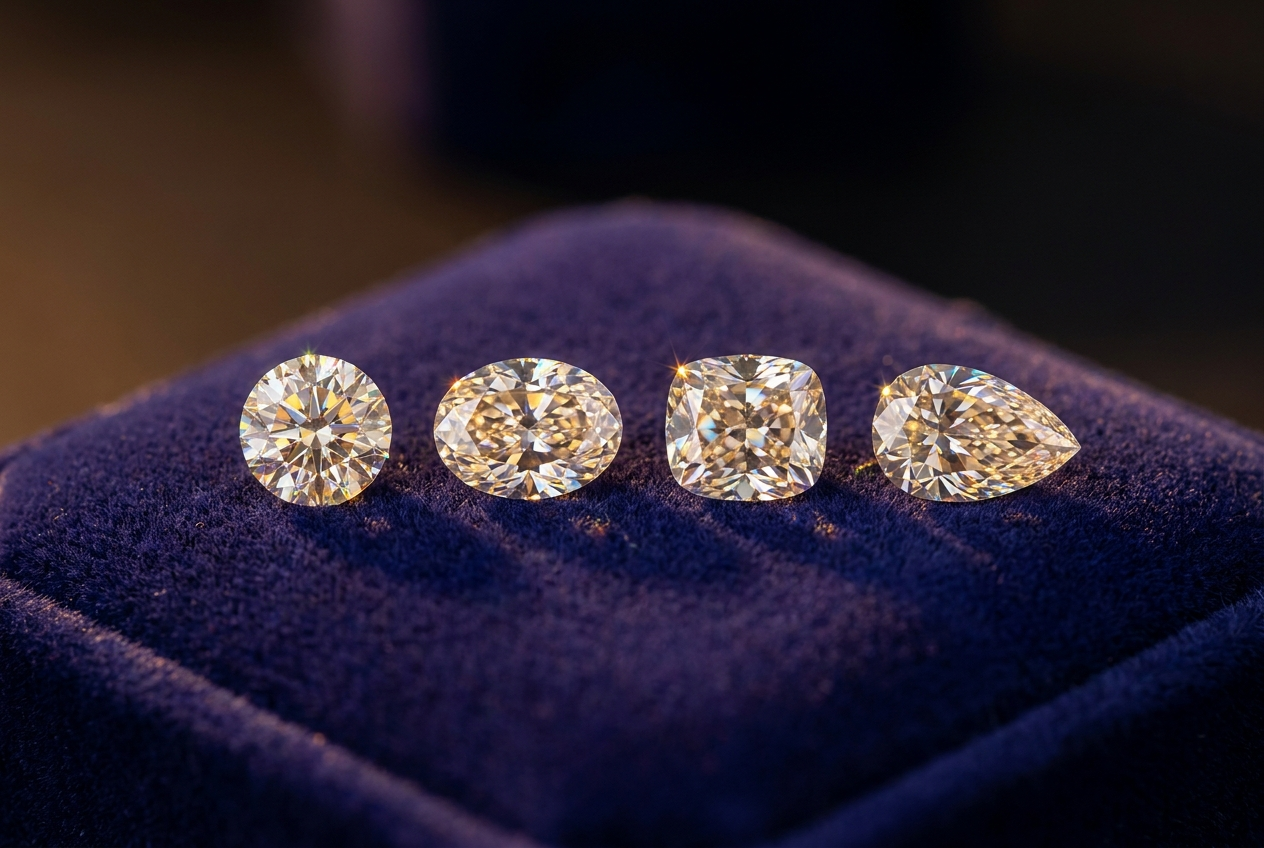
Carat is a unit of weight, not size. One carat equals 0.2 grams. Two diamonds of the same carat weight can look different in size depending on how they are cut, and price tends to jump at popular round weights like 1.00 and 2.00 carats. If size matters to you, a stone just under a round weight can look nearly identical for noticeably less.
Reading the 4Cs together
| The C | What it measures | Buyer tip |
|---|---|---|
| Cut | How well facets return light (Excellent to Poor) | Prioritize it; it drives sparkle |
| Color | Absence of color (D to Z) | Near-colorless often looks colorless once set |
| Clarity | Inclusions and blemishes (FL to I) | Choose eye-clean rather than flawless to save |
| Carat | Weight, where 1 ct = 0.2 g | Just under a round weight stretches the budget |
No single C makes a great diamond. The art is balancing all four, led by cut, to get the most beautiful stone for your budget.
See the 4Cs for yourself
The best way to understand the 4Cs is to compare diamonds side by side under the same light. Explore our bridal collection, or let our diamond and gemstone sourcing team bring graded options to you. When you are ready, book an appointment and we will walk through every grade together.
Sources
- GIA (Gemological Institute of America), the 4Cs of diamond quality and grading scales. gia.edu
